
Marina Strocchi completed a degree in art in Melbourne (1979–82) and then went on a two-year sojourn to Europe, mainly Paris. She returned to Melbourne and worked as a community artist. Her first exhibition of paintings was held in 1995.
In 2021, Marina returned to her hometown of Melbourne after twenty-nine years in the Northern Territory, where she was closely involved in supporting the development of a number of First Nations artists. Initially, this was through establishing the Ikuntji Art Centre in 1992, and later through working with the Pintupi women at Kintore to catalyse their painting, which led to a vigorous and continuing output through Papunya Tula. During these decades, she developed her painting responses to the remote landscapes and narratives unique to the Central Desert.
Strocchi has held over fifty solo exhibitions, including a Northern Territory touring survey exhibition accompanied by a catalogue of works. Awarded an Arts NT Fellowship in 2019, Strocchi undertook a three-month residency in New York City. She has exhibited her work in the USA, Europe and throughout Australia. Her work is held in many major Australian institutional and private collections, as well as private collections in Europe and the USA. She has undertaken commissions, won awards and has been a multiple-time finalist in significant prizes, including the Wynne Prize, the Omnia Prize, the Alice Prize, the Fisher’s Ghost Award and the National Works on Paper Award. She is represented by Australian Galleries (Sydney and Melbourne) and Jan Murphy Gallery, Brisbane.
Now settled in the Yarra Valley, Strocchi is responding to memories of her life experiences and her new environment.
“My work is an intuitive response to nature and the built environment. I live outside the city, in the Wurundjeri/Yarra Valley area. I attempt to activate the feeling of being in the landscape, deconstructing and anthropomorphising the landscape and challenging the human-centred viewpoint of nature. Through layering and linework, my aim is to create a form of ‘spatial’ harmony: a place of refuge, as nature does. My work responds to the brilliant glare of the Australian light. I use the irregularities and patterns of a world where nature is the major stakeholder.”
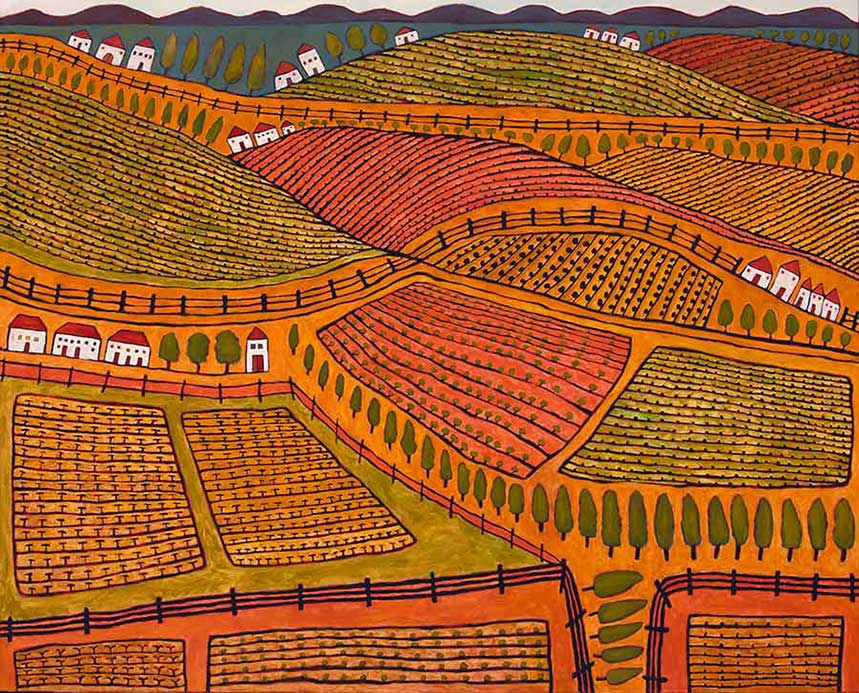
The vineyards of Madden's Lane (state 11) acrylic on linen 122x152cm 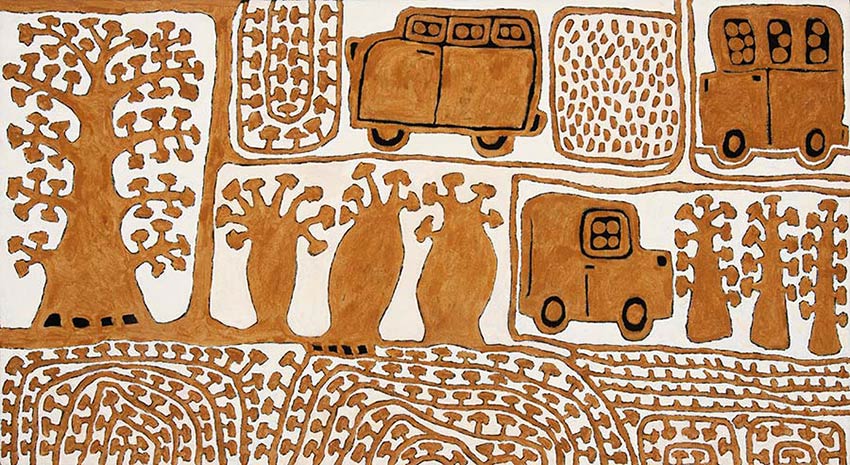
Three troopies acrylic on linen 65 x 120cm 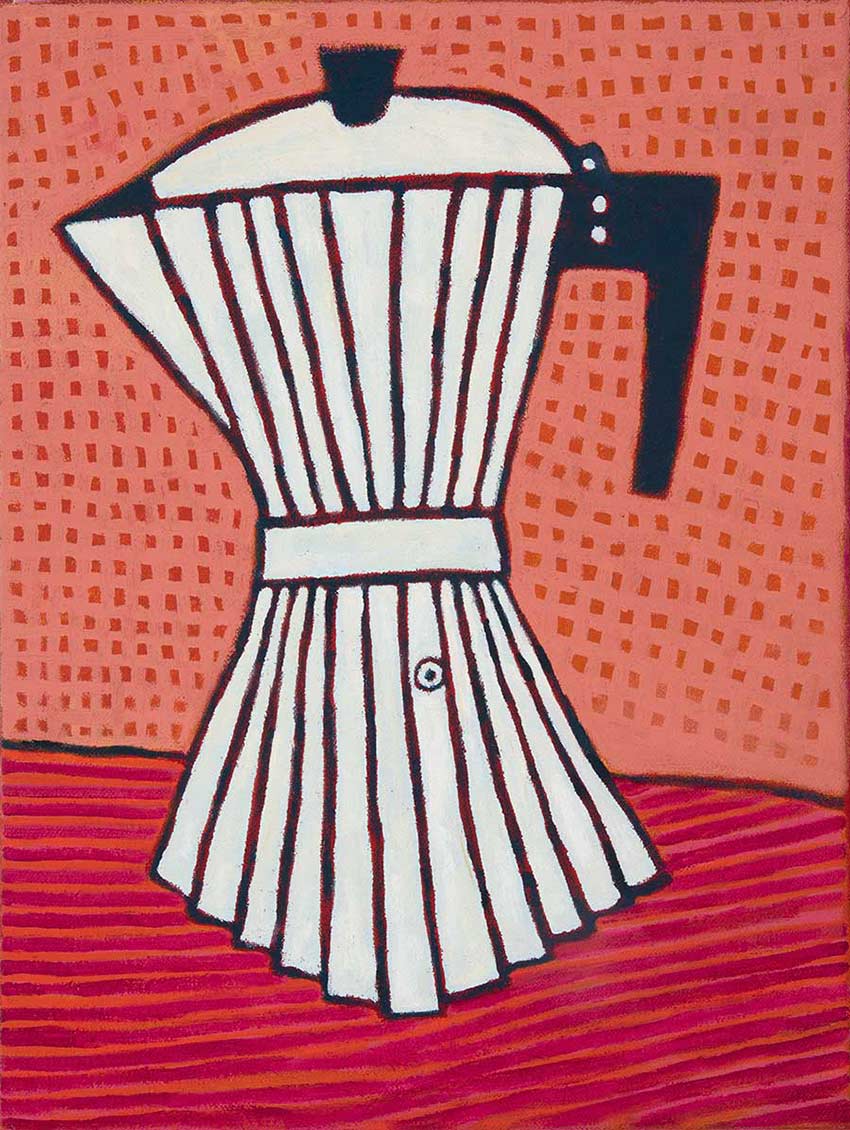
Coffee pot in pink acrylic on linen 35.3 x 25.3cm